Smartsheet’s new AI tool tracks corporate strategies, suggests fixes
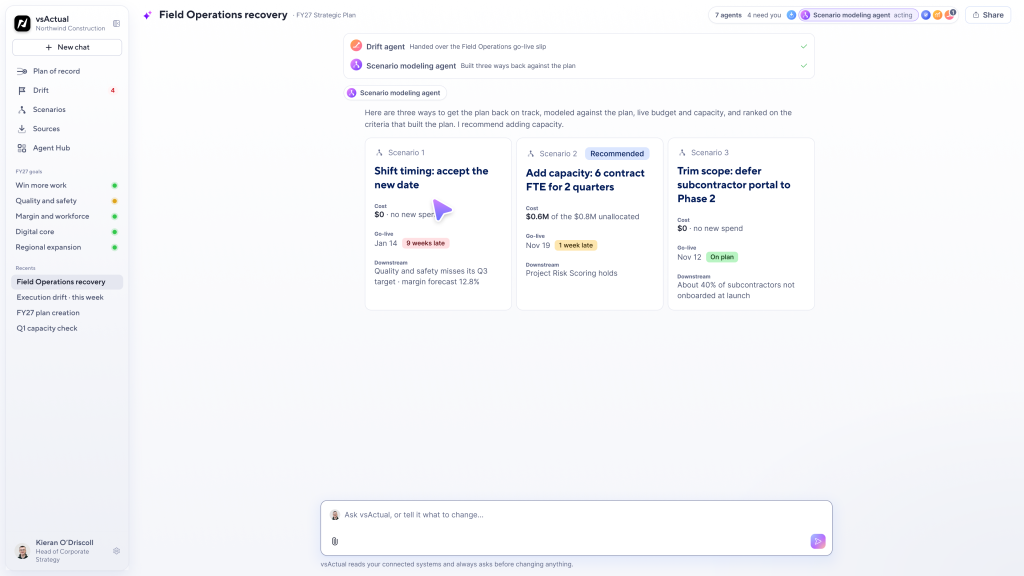
Work management software vendor Smartsheet has launched a new tool to help executives oversee company-wide strategies, with AI agents that monitor progress, identify problems, and recommend fixes. vsActual, announced Wednesday at Smartsheet’s Engage event, is a standalone “AI-native” application, separate from the company’s core work management software. It pulls data from a variety of business applications, including Oracle, Salesforce, SAP, and Workday, as well as work management tools such as Smartsheet itself. vsActual uses AI agents that carry out tasks on behalf of users, either in response to natural language prompts or running automatically in the background. An intake agent uses existing documents, such as presentation decks and spreadsheets, to help create a “plan of record” that includes goals, timelines, and budget and capacity limits. A planning agent helps with capacity planning and scenario modelling, and can be invoked when a plan needs to change. A drift agent can continuously look for data that highlights problems such as budget overruns, schedule delays, and resource conflicts. To do this, vsActual analyzes information from a range of connected applications, including conversations in Slack. vsActual agents can also recommend corrective actions, such as allocating additional staff to a project to address a predicted delay. Smartsheet Other agents include a data quality agent and a reporting agent that keeps users up to date on any changes across projects. “vsActual is aimed at the C-Suite, specifically the CFO and COO, who are often battling the issue of budget creep and timeline drift,” said Liz Miller, vice president and principal analyst at Constellation Research. Tracking the gap between strategies and actual outcomes — a concept that Smartsheet describes as “execution drift” — is a common challenge for executive teams, said Miller, and is typically only revealed in PowerPoint slides during quarterly planning sessions, or via emailed Excel spreadsheets. “vsActual proactively approaches decision-making, hunting for ‘drift’ and raising recommendations rooted in the context of operations of that business,” she said. vsActual agents rely on Smartsheet’s Execution Graph, a knowledge graph that maps the relationships between an organization’s tasks, projects, and strategic goals. vsActual agents can act autonomously, with ability to update data in third-party applications, when given relevant permissions. Human approval is required by default. The quality of a customer’s operational and financial data will be key to the accuracy of vsActual’s outputs, said Miller. “The tenet that AI is only as good or as accurate as the data, prompts, and guardrails in which it operates is certainly true here,” she said. “This is why the scenario recommendations in vsActual are rooted in live project and business data and grounded in business context via the Execution Graph.” She added that organizations should establish necessary guardrails and processes to ensure that agents have been “tested, trained, and grounded” before being assigned to complete tasks autonomously. Another priority is ensuring that systems are in place to enable human intervention and judgment when needed, she said. Smartsheet has been adding its own strategic planning features to its core work management platform for some time, including new scenario modelling and portfolio tracking tools launched at last year’s Engage. However, the arrival of vsActual marks a more significant shift in its focus. “Smartsheet vsActual is the company’s clearest move yet from managing tasks to governing strategy, budget, and capacity, and the [Engage] keynote demo made a strong case,” said Keith Kirkpatrick, vice president and research director at The Futurum Group, in a blog post on Wednesday. vsActual competes with a range of existing applications that address strategic planning, financial operations, and objective and key result (OKR) tracking, said Miller. These tools pull in data for strategy, but are “largely tethered to the primary platform,” such as an ERP or HCM system, and “can fall short of establishing workflows that actually recommend or act,” she said. The launch involves an expansion in Smartsheet’s target customer base, said Kirkpatrick, moving from bottom-up adoption among project managers and operations teams to also cater to the requirements of senior executives and strategy offices. “The [vsActual] concept is sound, but the launch asks Smartsheet to sell to a new buyer and to sell a product unlike the one it is known for,” he said. vsActual is now in early access, with general availability planned for early 2027. Pricing information has not been disclosed, but Smartsheet confirmed that it will involve usage-based billing.
This is a summary aggregated from Computerworld. Read the complete article on the original site:
Read full article at Computerworld