The Google Pixel 11 Pro XL: A smarter phone for getting things done
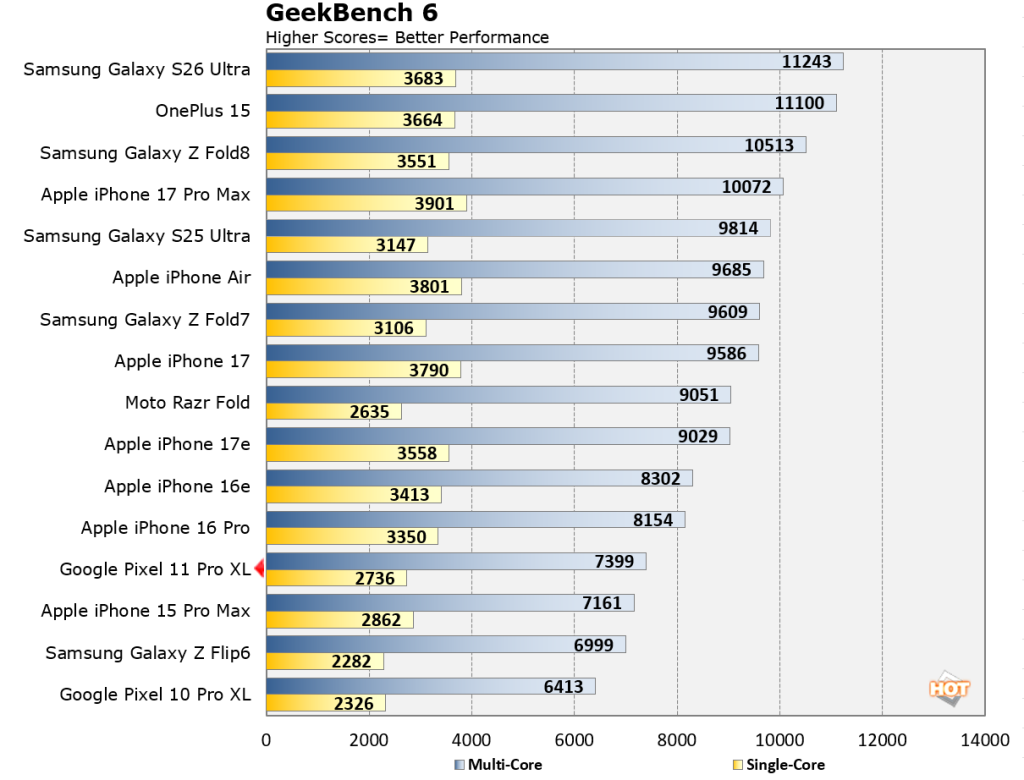
The new Google Pixel 11 Pro XL doesn’t dramatically reinvent the company’s flagship smartphone formula. From a hardware perspective, this year’s model represents an incremental update. But after spending time with Google’s latest full-featured Pixel, I’ve found that some of its most meaningful improvements for business users aren’t necessarily the things that stand out on a spec sheet or benchmark chart. Starting at $1,299 with 256GB of storage, the Pixel 11 Pro XL features a 6.8-in. Super Actua LTPO OLED display, Google’s new Tensor G6 processor, a 5115mAh battery and an updated triple-camera system. Google also pledges seven years of operating system, Android security and Pixel Drop updates. The hardware is very good, but Google’s deeper integration of Gemini with Android and other thoughtful software features are what make this device more interesting. Tensor G6 performance: The numbers don’t tell the whole story Google’s Tensor processors have never been benchmark chart-toppers, and the Tensor G6 doesn’t change that. In Geekbench 6, the Pixel 11 Pro XL scored 2,736 single-core and 7,399 multi-core numbers. That’s a healthy improvement over the Pixel 10 Pro XL’s 2,326 and 6,413, respectively, but well behind devices like Samsung’s Galaxy S26 Ultra (at 3,683 and 11,243) powered by Qualcomm’s latest SoCs. Dave Altavilla In 3DMark Wild Life, the Pixel 11 Pro XL scored 13,761, essentially neck-and-neck with Apple’s iPhone 16e at 13,627, though still far behind current gen flagships like the Galaxy S26 Ultra at 31,036. There’s an important disconnect, however, between those numbers and actually using the phone. The Pixel 11 Pro XL feels fast and responsive in everyday use, whether moving between email and messaging apps, browsing complex websites or multitasking. Google claims the Tensor G6 delivers 25% faster web browsing and 15% faster application launches, while its TPU offers 50% more compute and up to 3.5X faster on-device AI processing. For business and mainstream users, benchmark performance is less relevant unless you’re also a mobile gamer. Opening and switching between apps especially feels more responsive than other Android phones I’ve used as daily drivers. Add Google’s latest software efficiency and AI features, and the Pixel 11 Pro XL feels much more capable than the benchmark numbers suggest. Rambler is AI with an everyday, practical purpose Rambler may be the best example of Google’s efforts to minimize friction. Google has long offered excellent speech-to-text input, but Rambler takes voice input further. Instead of requiring carefully structured dictation, the Gemini-powered feature understands natural speech, including pauses and filler words, and turns it into cleaner written text. Google Rambler with Gemini AI Assist listens to you before generating text.Dave Altavilla In practice, it’s a significant improvement and allows me to make fewer dictation mistakes, whether writing emails or texting. Being able to speak naturally and have the phone turn those thoughts into clean, well-crafted text is genuinely useful, and auto punctuation also seems improved. This is the kind of AI functionality I want from a business-focused device: technology that removes friction and makes me more efficient, rather than shoehorning in AI just for AI’s sake. Gemini Intelligence also extends contextual assistance across more than 40 apps. Google can surface flight information when you’re discussing a trip, suggest adding events to Calendar or locations to Maps, and pull relevant information into Wallet. The Pixel 11 also expands Google’s Live Translation capabilities to real-time translation and dubbing of video and audio using on-device generative AI models enabled by the Tensor G6. These features could be especially useful for international business and personal travel. HiLight is a good idea that needs more flexibility Pixel 11 Pro XL HiLight alerts that Gemini is active.Dave Altavilla HiLight is a new software feature and integrated RGB LED array on the rear camera bar that provides visual feedback when Gemini is active and displays different colors for incoming calls from selected contacts. The concept has real potential for business users. Put your phone face-down during a meeting and you could know whether something important requires attention without repeatedly picking up the device to check. Unfortunately, Google doesn’t expose enough configurability yet. I’d like to associate colors or patterns with an important email, Teams or Slack message, Calendar alert or priority contact. Google says message notifications from favorite contacts are coming, but the hardware appears capable of much more. Excellent display and cameras, with better battery life Dave Altavilla The Pixel 11 Pro XL’s 6.8-in., 1-120Hz LTPO OLED Super Actua display is excellent, with peak brightness now reaching 3,600 nits. It’s easily one of the nicest phone screens on the market, with plenty of punch in daylight and accurate, vibrant colors. Its speaker system remains strong as well, while the Pixel 11’s industrial design is an attractive evolution of Google’s familiar camera-bar aesthetic. As we’ve come to expect from Pixel phones, the camera system is also excellent, with a 50MP main sensor, 48MP ultrawide and 48MP 5X telephoto camera. Shots are crisp, with especially good low-light performance and telephoto capability. The Pixel’s color science has always been a bit drab for my taste, while others on my team call it more “accurate” versus the often more saturated rendering of Samsung Galaxy devices. Pixel 11 Pro XL Creator Suite video settings.Dave Altavilla New software features include Camera Looks, Magic Capture and Creator Suite. Camera Looks provides more control over how Pixel devices process photos at capture, while Magic Capture uses AI to analyze hundreds of frames to catch fleeting moments. Creator Suite offers perhaps more practical utility for professionals, with an integrated teleprompter and project organization tools for producing video and social content on the fly. Battery life appears improved as well. My observations are anecdotal currently, with specific benchmark testing still to come, but the Pixel 11 Pro XL seems appreciably more efficient than the previous generation. It’s not a groundbreaking leap, but battery life is solid and competitive with premium Android flagships like Samsung’s Galaxy S26 family. Some Chinese phone makers are operating in another class these days, with much larger silicon anode batteries and extremely fast charging, but that’s a different segment of the market in my opinion. In my day-to-day use, which is admittedly heavy, the Pixel 11 Pro XL reliably gets me through a full, long day, though I typically need to top it off again the following day on my Pixelsnap charger. Regardless, the Pixel 11 Pro XL’s 5115mAh battery can reach a 75% charge in roughly 30 minutes with a compatible 45W charger, while Pixelsnap Qi2.2 wireless charging tops out at 25W. So, at least there are well-rounded power options here. Security and long-term support matter The new Tensor G6 works alongside Google’s new Titan M3 security coprocessor and Trusted Execution Environment, with post-quantum cryptography extending into the device’s secure boot process. The Pixel 11 Pro XL also includes anti-phishing, anti-malware and scam protections. Combined with seven years of OS and security updates, Pixel devices remain a compelling Android platform for organizations that intend to keep phones in service fleets for several years. Pixel 11 Pro XL: Incremental hardware, better overall experience Dave Altavilla The new Google Pixel 11 Pro XL doesn’t deliver a major generational hardware upgrade. Its conventional benchmark performance trails the fastest flagship phones, physical changes are modest, and most Pixel 10 Pro XL owners will likely have little reason to rush out and upgrade. That said, Google’s differentiation with its Pixel series increasingly comes from the intersection of Android, its Tensor silicon, Gemini AI and the company’s broader services ecosystem. Rambler demonstrates particularly well why that approach makes a difference. The feature obviously doesn’t require massive horsepower, but this type of on-device AI can make a measurable difference in how efficiently someone uses a smartphone throughout their workday. For business users coming from an older Pixel or another Android device, the Pixel 11 Pro XL is a polished, secure and highly capable productivity, creation and consumption device with an excellent display, great cameras, solid battery life and increasingly useful AI features. The bottom line is that this is an evolutionary Pixel launch. But Google’s software and AI integration make the overall experience more compelling than hardware specifications alone would suggest.
This is a summary aggregated from Computerworld. Read the complete article on the original site:
Read full article at Computerworld